
Pride Month 1 to 30 June 2026: More Than a Logo Change

By Rose Ruggiero, Co-Chair, E.ON Pride Network

LGBTQ+ is an acronym that stands for Lesbian, Gay, Bisexual, Trans, and Queer. The little plus sign at the end there carries a lot of weight. It covers the full range of sexual orientations and gender identities that are not captured by those five letters alone, including asexual, intersex, and non-binary people, among others. You will sometimes see longer versions of the acronym, such as LGBTQIA+, which make some of those identities more explicit. For simplicity, this blog uses LGBTQ+ throughout, but the plus is not an afterthought. It represents real people.

Every June, the pattern is familiar. Logos turn rainbow. Social feeds fill with colour. Companies launch Pride-themed campaigns, post a supportive message, and then, on 1st July, everything slips back to grey, beige, and business as usual.
There’s no shame in that. Visibility matters. But visibility without substance is not inclusion. It’s performative. And for the LGBTQ+ people working inside those organisations, there is often a painful gap between the external marketing campaign, and what is actually experienced day to day.
As a trans woman working in a large corporate environment, I have experienced that disconnect personally. At times, public messaging around inclusion has felt polished and confident, while privately I have still been assessing whether a room, a conversation, or a new colleague is actually safe. I consider myself fortunate to now work for a European company where equality and inclusion are not treated as branding exercises, but are embedded in strategy and everyday practice. That should not be the exception.
This blog is an attempt to explain the history of my community, why pride month is more necessary than ever, and what you can do to show real allyship. Not just as co-chair of the E.ON Pride Network, but also from lived experience, because for me and my community, the stakes are our lives and livelihoods.
Why Pride Started: The History You Need to Know
Pride did not begin as the party you may know it as. It began as a riot.
On 28 June 1969, police raided the Stonewall Inn, a gay bar in Greenwich Village, New York. At the time, queer communities in these neighbourhoods were used to being harassed by police simply for daring to exist in public. Same-sex sexual activity was criminalised across almost all US states, and policing practices were often used to target LGBTQ+ people, including through arrests and public humiliation. Gender non-conformity was also heavily policed, with laws and enforcement frequently used against people seen as dressing outside expected gender norms. The Stonewall Inn was one of the few places where LGBTQ+ people, particularly Black and trans people, as well as young people, many of whom were simultaneously experiencing housing insecurity, could exist with any degree of safety.

That night, the community fought back. The uprising lasted several days. It was led in significant part by trans women of colour, including Marsha P. Johnson and Sylvia Rivera, who are often written out of mainstream Pride histories. Their contribution deserves to be named clearly and remembered.
A year later, in June 1970, the first Pride marches took place in New York, Los Angeles, San Francisco, and Chicago. They were explicitly political. Participants were demanding decriminalisation, an end to police harassment, and basic civil rights. The atmosphere was defiant, not festive.
Over the following decades, Pride grew and changed. It spread globally. It became more visible, more commercial, more celebratory. In 1992, the World Health Organisation removed homosexuality from its list of mental disorders. Section 28, which prohibited the promotion of homosexuality in UK schools, was not repealed until 2003. Same-sex marriage became legal in England and Wales in 2014.
These were hard-won gains, achieved by activists who faced violence, arrest, and social exclusion.
But the work is not finished. In 2026, trans rights in particular are under sustained political attack in the UK and internationally. Conversion therapy remains legal in the UK for trans people, despite widespread condemnation and repeated calls for a full ban. Hate crimes against LGBTQ+ people have risen year on year. The legal protections that exist are being actively contested.
Understanding this history is not optional background reading. It is the foundation for understanding why Pride still matters, and why the work of inclusion is urgent, not palliative.
A Glossary of Terms
Language in this space evolves, and getting it wrong is a common source of anxiety for well-meaning cisgender and heterosexual people. This glossary is not exhaustive, but it covers the terms you are most likely to encounter in a workplace context. The goal is not perfection. The goal is informed, respectful communication.
Sexual Orientation
Gay: An umbrella term for people who are attracted to people of the same gender. Most commonly used to describe men attracted to men, but used by people of all genders.
Lesbian: A woman who is attracted to other women. Some non-binary people also use this term.
Bisexual: A person who experiences attraction to more than one gender. Bisexuality does not require equal attraction to all genders, and being in a relationship does not mean you are suddenly gay or straight.
Pansexual: Attraction to people regardless of gender. Some people prefer this term to bisexual; others use them interchangeably. Both are equally valid.
Asexual: Someone who experiences little or no sexual attraction. Asexual people may still experience romantic attraction. Asexuality is a spectrum, not a single fixed state.
Queer: A reclaimed umbrella term used by many LGBTQ+ people to describe identities that fall outside heterosexual and cisgender norms. It was historically used as a slur, and some older LGBTQ+ people still experience it that way. Do not use it to describe someone unless they have used it about themselves.
Gender Identity
Cisgender (cis): A person whose gender identity matches the sex they were assigned at birth. This is not a political term. It is simply a descriptor, in the same way that 'straight' is a descriptor.
Transgender (trans): A person whose gender identity differs from the sex they were assigned at birth. Trans is an umbrella term covering a wide range of identities and experiences. It includes trans men, trans women, and non-binary people.
Non-binary: Someone whose gender identity does not fit neatly into the categories of man or woman. Non-binary people may identify as both, neither, somewhere in between, or something entirely outside those categories.
Gender fluid: Someone whose gender identity shifts or changes over time or in different contexts.
Gender dysphoria: The distress that can occur when a person's gender identity does not align with the sex they were assigned at birth. Not all trans people experience dysphoria, and dysphoria is not a requirement for being trans.
Intersex: A person born with physical characteristics that do not fit typical definitions of male or female. This is a biological characteristic, not a gender identity. Intersex people have the same range of gender identities as anyone else.
Other Important Terms
Pronouns: The words used to refer to someone in the third person: he/him, she/her, they/them, and others. Using someone's correct pronouns is a matter of basic respect. Getting them wrong, and not correcting yourself when you do, causes real harm.
Deadnaming: Referring to a trans person by their name before transition. This is harmful and should be avoided even if done accidentally.
Coming out: The process of disclosing one's sexual orientation or gender identity. It is not a single event. LGBTQ+ people come out repeatedly throughout their lives, in different contexts, to different people. It is always their choice, not yours to make for them.
Outing: Disclosing someone else's LGBTQ+ identity without their consent. This can have serious consequences for a person's safety, relationships, and employment. It is never acceptable.
Allyship: Active support for LGBTQ+ people, particularly from those who do not identify as LGBTQ+. Allyship is a practice, not a badge. It requires ongoing effort, not a one-time declaration.
LGBTQ+: An acronym standing for Lesbian, Gay, Bisexual, Trans, Queer/Questioning, and others. The plus sign acknowledges the full spectrum of identities not captured by the named letters.
How to Be a Real Ally: Tips That Actually Make a Difference
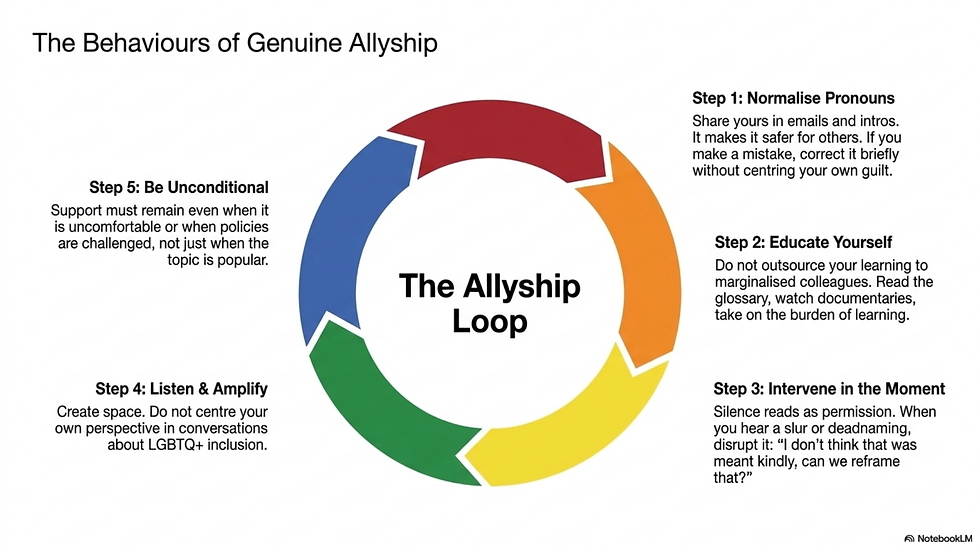
Allyship is not a feeling. It is a set of behaviours. Here are the ones that matter most in a workplace context.
1. Use and normalise pronoun sharing
Add your pronouns to your email signature, your LinkedIn profile, and any name badge or introductory slide you use. When you share your pronouns unprompted, you make it safer for others to do the same. You also signal that your organisation treats gender identity as something worth acknowledging.
If you are not sure of someone's pronouns, it is better to ask politely once than to guess and get it wrong repeatedly. If you do make a mistake, correct yourself briefly, do not make a long apology that centres your discomfort, and move on.
2. Intervene when you witness exclusion
Allyship is most visible and most valuable in the moment. If you hear a slur used as a joke, a colleague deadnamed, or someone's identity dismissed, say something. You do not need a perfect script. 'That is not okay' or 'I do not think that was meant kindly, can we reframe that?' is enough to change the dynamic.
Silence is not neutral. In these moments, it reads as permission.
3. Educate yourself and do not outsource it
The LGBTQ+ people in your organisation are not a resource. Their role is not to explain their identity to you every time you have a question. Use the glossary above. Read widely. Watch documentaries and listen to podcasts made by LGBTQ+ creators. The information is available.
Asking someone to educate you about their own marginalisation, when that information is freely available, puts the burden of your learning on the person who already carries the most weight.
4. Support policies, not just people
Individual kindness matters. But structural change is what creates safety at scale. Push for inclusive language throughout the employment lifecycle[KB1] , particularlary in your HR policies. Advocate for gender-neutral toilets in your offices. Ask whether your healthcare provision covers trans-specific care. Review your recruitment processes for bias.
You do not need to be in HR to advocate for any of this. You need to be willing to make space for marginalised communities.
5. Listen more than you speak
In conversations about LGBTQ+ inclusion, if you are not LGBTQ+ yourself, your role is primarily to listen, learn, and amplify. Not to lead the conversation, centre your own perspective, or explain what LGBTQ+ people should want from inclusion efforts.
Good allyship creates space. It does not fill it.
6. Do not make it conditional
Allyship that only shows up when it is comfortable is not allyship. If you support LGBTQ+ colleagues when the topic is popular but go quiet when someone raises a specific concern, challenges a policy, or calls out a micro-aggression, you have signalled that your support has limits.
People notice. And they adjust what they share with you accordingly.
Why Pride Still Matters in 2026: Not Just Paying Lip Service
Some people inside organisations argue that Pride is no longer necessary. That the battles have been won. That LGBTQ+ people have equal legal rights now, so why the continued focus?
Here is why that argument misses the point.
The legal floor is not the ceiling
Having a legal right does not mean it is exercised safely. LGBTQ+ people still experience discrimination in hiring, promotion, and day-to-day interactions. A 2023 Stonewall report found that more than a third of LGBTQ+ employees in the UK had hidden their identity at work for fear of discrimination. Half of trans people had done the same. Legal protection does not make someone feel safe enough to be themselves at work.

Trans rights are being actively contested
In 2026, trans people in the UK are navigating a political environment that has become significantly more hostile. Proposed changes to the Gender Recognition Act (GRA) 2004, media coverage that frequently frames trans identity as a debate rather than a lived reality, and a documented rise in transphobic hate crimes are all part of the current landscape.
That constant noise does not stay outside the workplace. It shapes the background calculations you make every day: how visible to be, how much to share, how to present yourself in professional spaces, and how much emotional energy is spent simply staying steady while your existence is being debated in public. The question is whether your organisation actively offsets that pressure, or leaves people to carry it alone.
Inclusion drives retention and performance
This is also a business case, and it is a strong one. Research consistently shows that employees who feel they can bring their whole selves to work are more engaged, more productive, and less likely to leave. LGBTQ+ talent, like all talent, goes where people feel valued.
Organisations that treat Pride as a PR exercise, rather than a genuine commitment, are increasingly being called out for it. LGBTQ+ job seekers research inclusion records before they apply. Glassdoor reviews mention this. Social media amplifies it.
The gap between stated values and actual culture is now visible. And it has a real impact on turnover and profits.
Rainbow-washing is damaging, not just unhelpful
When a company changes its logo in June and does nothing of substance, it doesn’t just fail to help queer people. It actively undermines trust. LGBTQ+ employees who see their employer perform inclusion without practising it become more disengaged, they feel included in branding but excluded in practice. Which can feel worse than not being seen at all.

Every year, LGBTQ+ people document corporate rainbow-washing. They notice when a company's Pride logo is only visible in countries where it is culturally safe, but not in regions where LGBTQ+ rights are less protected. They notice when there is no internal employee resource group, no gender-neutral facilities, no trans-inclusive healthcare policy, and yet the external brand is full of rainbow imagery.
The public will notice. And they talk about it.
What genuine commitment looks like
It looks like leadership that speaks about LGBTQ+ inclusion outside of Pride Month. It looks like HR policies that are reviewed annually with input from LGBTQ+ employees.
It looks like a clear, well-communicated process for reporting discrimination or harassment, with evidence that reports are taken seriously. It looks like employee resource groups that are properly resourced, not just permitted to exist.
It looks like a company that asks its LGBTQ+ employees how they are doing, and then listens to the answer.
What Employers Can Do Right Now
If you are reading this as an employer or HR professional and wondering where to start, here are five concrete actions you can take before the end of June.
• Audit your HR policies for inclusive language. Check parental leave, dress code, healthcare, and anti-discrimination policies. Identify gaps.
• Set up or properly resource an LGBTQ+ employee resource group. Give it a budget, a senior sponsor, and a clear mandate.
• Brief your managers on trans inclusion specifically: pronouns, confidentiality, and how to support a colleague who is transitioning at work.
• Review your recruitment and onboarding processes. Are you collecting diversity data in a way that includes trans and non-binary identities? Are you using inclusive language in job adverts?
• Ask your LGBTQ+ employees what they need. Not publicly, not performatively, but through a private, structured conversation or anonymous survey. Then act on what you hear.
If you are not sure where to start or you want support putting any of this into practice, Kate at The HR Hero works with employers across the UK on inclusion strategy, policy development, and people management.
Book an SOS Call with Kate: https://www.thehrhero.co.uk/sos-call
About the author

Rose Ruggiero is co-chair of the UK chapter of the international employee diversity network, Pride @ E.ON. In her day role, she supports corporate customers through the complete energy lifecycle, managing the complex processes involved in energy and gas supply contracts for E.ON UK. She is a trans woman and an advocate for LGBTQ+ inclusion in the workplace.
Photo credit Michelle Morris
Disclaimer: Every reasonable effort is made to make the information accurate and up to date, but no responsibility for its accuracy and correctness, or for any consequences of relying on it, is assumed by the author or publisher. If you are unsure about how this information applies to your specific situation, please seek expert/legal advice.


