
Five Years of Making HR Human

What I have learned, what has changed, and what is yours to take away this July

Five years ago, I started The HR Hero with a straightforward idea: that good HR should not feel like a legal minefield, and it should not be a luxury reserved for businesses with a full HR department and a legal team on speed dial.
Small businesses have real people in them. Real situations. Real problems that do not wait for the right structure to materialise. I wanted to be the person business owners could actually call when something went wrong, or better still, the person who helped them make sure it did not.
Five years on, that belief has not shifted. What has shifted is everything I have learned along the way, and how much sharper that makes the support we can give you.
In that time, I have worked with organisations across a wide range of sectors, supported managers through disciplinaries, grievances, redundancies and TUPE transfers, helped employers get the basics in place before they needed them, and sat with business owners in some genuinely difficult moments. The common thread in almost every situation is the same: HR problems are people problems, and people problems are manageable when you have the right foundations and the right support in place.
To mark the five-year milestone, I am doing something I do not do nearly often enough: sharing the story behind the business and the things I have learned that did not come from a textbook. And because it is our fifth birthday, we are giving away five free resources, one each week in July, one for each stage of the employment lifecycle. Details at the end of each section.
Every business has a story. Usually several. These are the five I think are worth telling on a fifth birthday.
The Five Stories Behind The HR Hero
1. Why I Started The HR Hero
The origin story matters. Not because it is sentimental, but because it tells you what someone actually believes about the work they do, and whether they are doing it for the right reasons.
For me, the reason was straightforward. After twenty-five years managing people, working across organisations of different sizes, I kept seeing the same pattern: organisations had no HR support at all, or they were paying for it in the worst possible way, by finding out after the fact that they had handled something incorrectly. The employment tribunal claim, the settlement, the awkward exit, the team that fractured because a difficult situation was left too long.
The support that could have prevented most of it was not complicated. It was just not there. And the HR options that did exist were often either too expensive, too corporate, too slow, or too far removed from what it is like to run a small business.
I have worked in both the public sector, where we were drowning in HR policy, procedures and complex processes, and in private organisations where there has been none. My approach is to find the middle ground and be flexible with that, depending on the needs of the organisation.
What I have created with The HR Hero is the HR and people management service I needed when I helped grow a business from 30 staff to over 120.
That is what The HR Hero is built on. Practical, human HR support for businesses that need someone in their corner, who will really get to know their organisation and understands how to manage teams of people and lead organisations to achieve growth.

2. The Moment I Stopped Hiding
There is a stage most business owners go through, especially in professional services, where they know exactly what they are good at but find it oddly difficult to say it clearly to the people who need to hear it. You have the qualifications. You have the experience. Saying it out loud, directly, to the right people, can feel harder than doing the actual work.
Imposter syndrome does not discriminate by sector, and HR professionals are not immune to it. Understanding employment law and how it impacts a business does not automatically make you comfortable telling a room full of business owners that they need you.
The turning point came when an employer reached out after conflict within the senior team had reached crisis point. She was overwhelmed and felt there was no way forward. We worked closely together from that moment, rebuilding trust, strengthening the leadership team, and helping the business move forward. Two years later, the business is thriving and has opened another location.
What I have found is that once you get clear and direct about what you do and who it is for, the right clients find you faster. The conversations become easier. And the work becomes more satisfying because you are doing it for people who genuinely want what you offer, not people you have had to talk into it.

3. What I Learned the Hard Way
Twenty-five years managing people means twenty-five years of watching what happens when things go wrong. Some of those lessons are from my own career and decisions. Some have come from sitting alongside clients in the middle of situations that could have been avoided. All of them have made me better at spotting the warning signs before a situation becomes a crisis.
The hard lessons in HR tend to cluster around the same themes: the conversation that was put off too long, the process that was skipped because it felt unnecessary, the performance issue that was managed with hope rather than structure, the redundancy that was announced without the right preparation. None of these are unusual. All of them are expensive in one way or another.
One of my biggest lessons came when we doubled the size of a location overnight. The senior leaders and I had spent months preparing and planning, and we were excited about the expansion. What I failed to do was communicate the change properly to the existing team or involve them in the plans. As a result, when we opened to the public, staff were disengaged, not fully on board, and struggled to support the growing business. Turnover and absence increased significantly, and it took eighteen months to get back on track. It was a huge lesson, and one I now take into every change programme.
The businesses that navigate HR well are not the ones that never make mistakes. They are the ones that learn from them quickly and build something more solid as a result. That is what good HR support is supposed to do: help you turn the awkward experience into a better process.

4. The Invisible Truth About HR That Nobody Says Out Loud
After twenty-five years, there are things I know that most business owners simply do not. Not because the information is hidden, but because nobody takes the time to explain it clearly, without jargon, in a way that is actually useful to someone who is running a business and managing a team.
HR has its own language and its own technical terms, which can so easily be misunderstood by those who are running a business or leading an organisation. It is so easy for HR professionals who understand it best to wrap it in language that creates distance rather than clarity. The result is that business owners and leaders either switch off, assume it does not apply to them, or end up in front of an employment tribunal wondering why nobody told them this mattered.
What I have learned is that communication is everything. Employment law and HR processes are not there to catch employers out; they are there to create clarity, fairness and consistency.
The problems usually arise when people are surprised, expectations are assumed rather than explained, or a process is followed without anyone really understanding why it matters. Good HR means making the process clear before it is needed, leaving as little room as possible for misunderstanding, and helping managers understand how each step should be handled in their own organisation.
I say this not to alarm people, but because business owners and leaders who hear it and take it seriously make better decisions. And better decisions mean fewer problems, less reactive crisis management, and more time and energy spent on the parts of running an organisation that are actually enjoyable.

5. The Moment I Stopped Trying to Appeal to Everyone
Early on, the instinct is to keep the offer broad. To say yes to everything. To position yourself in a way that could theoretically suit any kind of client. It feels like the safe option. What it actually does is make your message blurry and your marketing exhausting.
The HR Hero was, for a period, trying to be too many things to too many people. The positioning was safe. The language was generic enough to cover most bases. And while the work was good, it was not landing the way it needed to.
The HR Hero is for businesses that want to grow and expand, as well as organisations working directly with children, young people and vulnerable adults. These are the organisations where my experience is strongest and where I can make the greatest contribution.
The HR Hero is built for organisations with one to one hundred employees in each location. Owner-managed, education or charity sector, often with a small leadership team and often with no in-house HR function. Leaders who care about getting people management right, but who need someone practical and experienced in their corner rather than a lengthy policy document, or risk-averse advice that does not consider the wider needs of the business.
When the message got that clear, the right work started coming. The clients who arrived already understood what they were getting. The conversations became more direct. And the support I was giving became more genuinely useful because it was going to the people it was designed for.
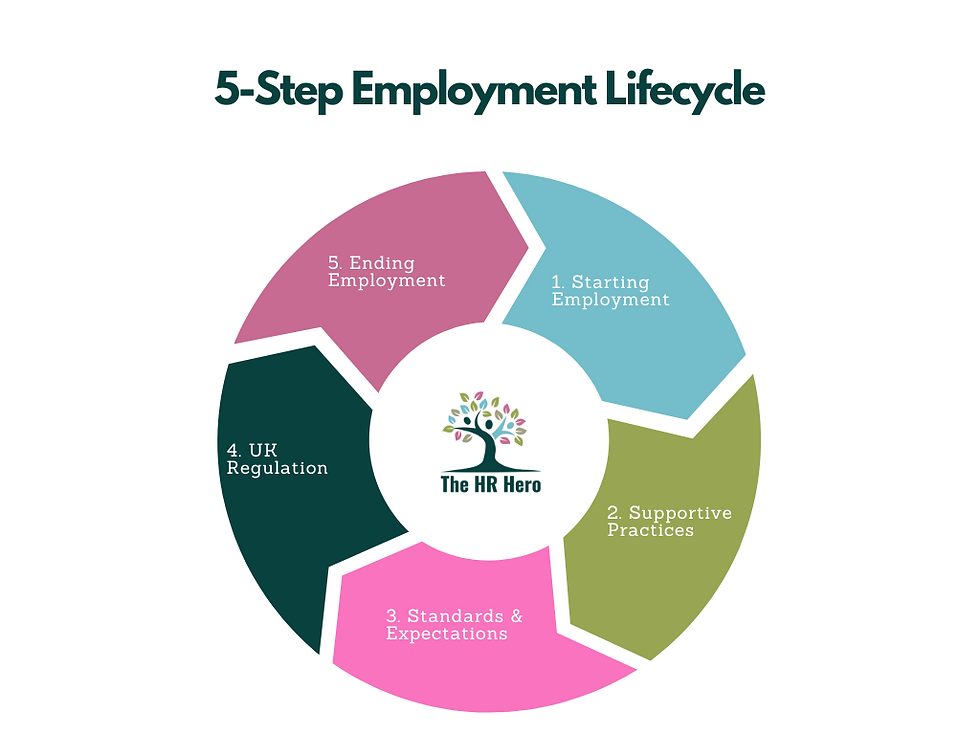
Five Stages. Five Years. What Good HR Looks Like Across the Employment Lifecycle.
The employment lifecycle is the framework I use to help business owners think about HR in a way that is structured rather than reactive. Most HR problems do not come out of nowhere. They come from something that was not handled well earlier in the relationship: a vague contract, an onboarding that did not set clear expectations, a performance issue that was left too long, a process that was skipped because it felt like overkill at the time.
The five stages are:
• Starting Employment
• Supportive Practices
• Standards and Expectations
• UK Regulation
• Ending Employment
Each one matters. Each one carries risk if it is done badly. And each one is manageable when you have the right approach.
To celebrate five years of The HR Hero, I am releasing a free resource each week in July, one for each stage of the lifecycle.
Stage 1: Starting Employment
Everything that comes later is shaped by how you start. The employment contract, the offer letter, the first few days, and the first few weeks. Most small business owners know they need a contract. Fewer are confident that what they have is legally compliant and actually reflects how they work.
Under the Employment Rights Act 1996, employees are entitled to a written statement of particulars from day one. That is not a nice-to-have. It is a legal requirement. And the statement needs to cover specific information: pay, hours, location, holiday entitlement, notice periods, and much more.
But the legal minimum is not always enough to protect you. A contract that meets the statutory requirements but leaves everything else vague will not help you when an employee disputes what was agreed, claims they were not told something, or argues that a particular working arrangement was implied rather than explicit.
Good onboarding goes further than the paperwork. It makes the unwritten rules visible. It tells a new starter not just what their job is, but how decisions are made, who to go to for what, what good performance looks like in your organisation, and how to raise a concern if they have one.
Many neurodivergent employees, in particular, find ambiguity at the onboarding stage very difficult to navigate. A clear written guide to how the business actually works, going beyond the standard policy documents, reduces the risk of early misunderstandings and gives everyone a fair start.
What good looks like at this stage:
• A legally compliant written contract in place from day one
• An offer letter that reflects what was actually agreed
• A structured first week with clear priorities and a named point of contact
• A written guide to how the business works, not just the policies
• Regular check-ins in the first three months, tapering as confidence grows
• Follow-up notes after early conversations confirming what was discussed and agreed
• A planned and expected probationary period process with structured reviews
A real example from The HR Hero:
Keen to Clean was established in 2021 and provides a high standard of cleaning services for both domestic and commercial clients.
Owner Melissa had single-handedly grown her company and was ready to take on her first employees. She contacted The HR Hero in 2024 and had an initial meeting with Kate. Melissa had a clear growth plan for her business and the type of supportive employer she wanted to be, but was worried about not knowing what she needed to put in place to employ staff.
Melissa then joined our Gold Membership, and The HR Hero guided her through the recruitment process to ensure it was lawful while also attracting the very best talent to her company. This included designing graphics and literature for recruitment, including a job advert for social media, job description, person specification and employment contract. The HR Hero was on hand to guide Melissa through the whole recruitment process, from advert to interviewing to her employees' first day.
Melissa now has a thriving business with an engaged, productive workforce.
“My Heroes. The HR Hero have supported me so much with absolutely everything. I absolutely loved what they did with the recruitment graphics for my social media and it looked so professional and clean, just how I wanted it. If you're in need of some HR support or advice, get in touch with these ladies.”
— Melissa, Keen to Clean
This week's free resource covers the starting employment essentials: what has to be in writing, what good onboarding looks like in practice, and the quick wins that stop small businesses getting caught out at the very beginning.
FRIDAY GIVEAWAY 1 OF 5 | WEEK 1 | STAGE 1: STARTING EMPLOYMENT New Starter Essentials Checklist Everything you need to get a new employee started, covering the key recruitment, compliance, HR administration and induction tasks needed to onboard a new employee, with space to record completion dates, initials and final employee and manager sign-off. Free to download this week. Download free this week at thehrhero.co.uk Want ongoing templates, resources and HR support? Join the HR Hero membership: thehrhero.co.uk/hr-support |
Stage 2: Supportive Practices
Day-to-day management is where the gap between good intentions and good practice tends to show up. Most managers in small businesses have never been trained to manage. They have been promoted because they were good at something else, or they are the owner or senior leader, doing everything themselves. That is completely normal. It also means that a lot of the behaviours that create HR problems are not malicious. They are just inconsistent.
Supportive practices are the everyday things that keep a team functioning well. That includes the policies that sit behind day-to-day decisions: holiday and flexible working, equality, diversity and inclusion, drugs and alcohol, wellbeing and menopause support, maternity and the wider family friendly picture including paternity, parental leave, adoption, bereavement and carers leave, and homeworking. None of these exist to slow a manager down. They exist so that when a request or a difficult conversation comes up, there is already a clear, fair answer rather than a decision made on the spot. The businesses that get this right are not the ones with the longest policy folder. They are the ones where managers actually know what the policy says and can explain it in plain terms when someone asks.
Alongside the policies, the day-to-day habits matter just as much: one-to-ones that actually happen, clear briefings before work is delegated, feedback that is timely and specific, and an environment where people feel able to raise a concern before it becomes a formal complaint.
The research on this is consistent. Teams that have regular, structured one-to-ones perform better, have lower absence rates, and are less likely to raise grievances. The one-to-one is not a bureaucratic box to tick. It is the most efficient management tool available for catching problems early, keeping communication clear, and making people feel that their work is seen.
One of the things I see most frequently is managers who avoid one-to-ones, or run them so informally that nothing useful is recorded or followed up. When a performance issue arises later, there is no trail. No evidence that standards were discussed, that support was offered, or that the employee was given a fair chance to improve. That absence of documentation is a problem in any formal process that follows.
Supportive practices also include how adjustments are handled. Whether an employee has a health condition, a caring responsibility, or a neurodivergent condition that affects how they work best, the conversation about what support looks like should happen before it becomes urgent. A manager who knows how to have that conversation early, calmly and practically will handle it better than one who is encountering it for the first time in a moment of crisis.
What good looks like at this stage:
• Regular one-to-ones with a consistent structure and written follow-up
• Clear briefings before tasks are delegated, including what done looks like
• Feedback that is timely, specific, and focused on behaviour and outcomes
• A visible and simple route for employees to raise concerns informally
• Early conversations about adjustments, before situations escalate
• Managers who know what to do and what to record
This week's free resource gives managers a practical framework for providing mental health support to staff.
FRIDAY GIVEAWAY 2 OF 5 | WEEK 2 | STAGE 2: SUPPORTIVE PRACTICES Wellness Action Plan A simple, ready-to-use assessment for one-to-one wellbeing support that actually works: what to cover and how to identify wellbeing support to prevent further absences and support people back to work. Free to download this week. Download free this week at thehrhero.co.uk Want ongoing templates, resources and HR support? Join the HR Hero membership: thehrhero.co.uk/hr-support |
Stage 3: Standards and Expectations
A common management trap is treating fairness as identical treatment. It is not. Fair management means holding consistent standards while also removing barriers that prevent someone from meeting them. Getting that balance right requires clarity about what the standard actually is.
Most performance problems I see in small businesses are not really performance problems. They are communication problems. The standard was not made explicit. The expectation was assumed rather than stated. The manager thought the employee knew what was expected, and the employee thought they were doing fine. By the time the conversation happens, both parties are frustrated and the situation is harder to resolve than it needed to be.
Setting clear standards is not about being a demanding employer. It is about giving your team a fair chance to succeed. When expectations are vague, performance conversations become adversarial. When they are clear, the same conversation becomes much more straightforward: here is what we agreed, here is where we are, here is what needs to change, here is how we are going to support that.
Performance management that is done well is also the single most important legal safeguard a business has. Employment tribunals are not impressed by good intentions. They look at whether the standard was communicated, whether the employee was given a genuine opportunity to improve, whether the process was followed consistently, and whether the outcome was proportionate. All of that depends on clarity at the standards and expectations stage.
Recent tribunal cases are worth noting here. In Khorram v Capgemini UK plc (2025), the tribunal found that the employer had failed to make reasonable adjustments for an employee with ADHD, including not providing realistic and achievable task-setting to prevent overwhelm. In Shevlin v John Wiley and Sons Ltd (2024/2025), the tribunal dismissed a harassment claim where performance feedback had been delivered in neutral, non-judgmental terms as part of ordinary management. The contrast is useful: neuroinclusive management is not the absence of standards. It is better standards, communicated more clearly.
What good looks like at this stage:
• Explicit standards for quality, pace, priorities and behaviour, written down and shared
• Regular check-ins against those standards, not just annual appraisals
• Early, calm conversations when performance drops, before it becomes a formal process
• Identifying barriers before escalating: is this a capability issue, or an environment, process or communication issue?
• Agreed adjustments recorded in writing with review dates
• Feedback that is specific, professional and focused on outcomes rather than personality
A real example from The HR Hero:
“The HR Hero quickly established strong and trusted relationships with our executive team, school leaders and central staff. They have provided valuable support on complex HR matters and are developing robust, process driven solutions that are strengthening consistency and practice across the trust. Their approach is responsive, professional and aligned with our organisational needs and strategic plan.”
— Kate Joiner, Head of People, Culture & Governance, Mercian Education Trust
This week's free resource gives you guidance for setting and communicating clear expectations in a way that is fair, legally sound, and genuinely useful when performance conversations need to happen. If you have people responsibilities in your team, share it with whoever runs one-to-ones.
FRIDAY GIVEAWAY 3 OF 5 | WEEK 3 | STAGE 3: STANDARDS & EXPECTATIONS Managers' Good Practice Guide to Performance Reviews A manager's guide to defining standards, communicating them clearly, and having the performance conversations that matter without it getting adversarial. Free to download this week. Download free this week at thehrhero.co.uk Want ongoing templates, resources and HR support? Join the HR Hero membership: thehrhero.co.uk/hr-support |
Stage 4: UK Regulation
Employment law changes. It does so regularly, and in recent years it has been changing faster than usual. The Employment Rights Act has introduced significant reforms, including changes to unfair dismissal rights, sexual harassment, whistleblowing and statutory sick pay. For businesses without an HR function keeping track, it is easy to fall behind without realising it.
The challenge with UK employment regulation for business owners and leaders is not that it is impossible to understand. It is that there is a lot of it, it updates frequently, and the consequences of getting it wrong are not always immediately visible. You can be non-compliant for months before anything happens. And then when it does happen, it tends to happen fast.
The areas where businesses are most commonly caught out include: contracts that have not been updated to reflect legal changes, policies that exist on paper but are not applied consistently, incorrect holiday pay calculations for part time staff, absence management that is not being handled in line with the Equality Act 2010, and redundancy processes that have not followed the correct statutory steps.
None of these are exotic edge cases. They are the bread and butter of employment tribunal claims, and they are almost entirely preventable with the right information and a bit of structure.
Being an accredited Breathe HR partner and a member of the CIPD means I am keeping up with the regulatory landscape so that the businesses I work with do not have to do it alone.
What good looks like at this stage:
• DBS and criminal records checks carried out and recorded correctly for any role that requires them
• A whistleblowing policy that staff actually know exists and trust
• A bribery policy that meets the requirements of the Bribery Act 2010, however small the organisation
• Data protection practice that goes beyond a policy on a shelf, including how personal data is stored, shared and disposed of
• Modern slavery awareness built into recruitment and supply chain decisions, even outside the businesses required to publish a statement
• Safeguarding arrangements that are current, understood by staff, and specific to organisations working with children, young people or vulnerable adults
A real example from The HR Hero:
Worcester Wheels is a not-for-profit charity providing community transport for people living in Worcester and the surrounding areas. They also run a community Friendship Hub, bringing people who are lonely and isolated together.
Kate met with and was instructed by the board of trustees to undertake an initial HR review. She identified that the employment contracts and HR policies were not fully aligned with the way the charity operates. The work included reviewing and updating key areas such as data protection, safeguarding and whistleblowing, alongside a consultation process with employees to update contracts and policies so they complied with employment law, supported their people, and reflected the school term-time funding the organisation receives. This has saved the charity approximately £25,000.
“Kate is always approachable and is my go-to person for anything HR related that I come across. She is always on the end of the phone when I need her and is always clear in her advice and instructions. Basically, Kate is my HR comfort blanket.”
— Dormston, Worcester Wheels
This week's free resource is a template letter acknowledging receipt of a Subject Access Request, in accordance with the Data Protection Act 2018.
FRIDAY GIVEAWAY 4 OF 5 | WEEK 4 | STAGE 4: UK REGULATION Data Protection Act 2018: Subject Access Request This letter is used to acknowledge receipt of a Subject Access Request, confirm that the request has been received, and explain the expected response timeframe in accordance with Information Commissioner's Office (ICO) guidance. Free to download this week. Download free this week at thehrhero.co.uk Want ongoing templates, resources and HR support? Join the HR Hero membership: thehrhero.co.uk/hr-support |
Stage 5: Ending Employment
Ending an employment relationship is the part of the lifecycle that carries the most legal risk, and the part where the quality of everything that came before it really shows. A redundancy process, a dismissal, a settlement or even a resignation handled badly can become expensive very quickly, and it also affects the company's reputation.
The employment tribunal system exists to provide a route for employees who believe they have been treated unlawfully. In 2023/24, there were over 200,000 employment tribunal claims lodged in England, Scotland and Wales. The most common cases included unfair dismissal, unauthorised deductions from wages, and discrimination. Many of those claims had their roots in situations that could have been managed differently much earlier in the employment relationship.
Ending employment fairly means following a fair process, having clear evidence, giving the employee a genuine opportunity to respond, and making a proportionate decision. Tribunals look at process as much as they look at outcome. A dismissal that was substantively justified but procedurally flawed will still result in a finding of unfair dismissal.
The most common mistakes at this stage are: failing to follow a fair procedure for redundancy, not exploring alternatives to dismissal, dismissing without proper investigation, failing to account for the impact of disability on the conduct or performance at the centre of a dismissal, and handling the final exit in a way that creates additional claims.
A real example from The HR Hero:
Lisa first contacted The HR Hero after receiving a customer complaint about a senior member of staff communicating inappropriately with them outside of working hours.
Kate quickly met with Lisa to understand the issue and provided support that led to an internal investigation, which resulted in disciplinary action.
Lisa then asked Kate to review the staff structure to ensure it was the best it could be for her organisation, alongside reviewing all HR policies and employment contracts to make sure they were up to date with current employment law.
“I asked Kate to help investigate an incident in the team. She was very professional and caring in the way she approached our investigation. She had a wealth of knowledge and advised and guided me throughout. Kate listened to the business needs and advised me on how to proceed. Kate works hard to help you and your company overcome difficulties. She has a kind, understanding and professional approach to her work. Kate helped me work out clear job roles and responsibilities within the company, which led to a management restructure. She keeps you informed throughout all the processes and guides and advises at each stage. The team feel more settled in who and when to approach, and who has responsibility for what throughout the day-to-day running of the business. We have put into place new staff contracts and an employee handbook, and updated policies. We now feel more confident that we have everything in place we need to settle, grow and flourish. I will not go anywhere else for HR support and highly recommend Kate to help you in any business situation that may arise.”
— Lisa
Following this work, Lisa joined the HR Hero Silver membership five years ago to ensure her employment contracts and HR policies remained up to date, protecting the organisation and supporting her staff team as it continued to develop. Her business has gone through a period of transformational growth.
This week's free resource gives you guidance for conducting a formal disciplinary meeting, supporting the chair in keeping the hearing focused, objective and procedurally sound. Share it with whoever in your business might need to chair one.
FRIDAY GIVEAWAY 5 OF 5 | WEEK 5 | STAGE 5: ENDING EMPLOYMENT Disciplinary Hearing: Meeting Structure This meeting structure is intended to provide a clear and consistent framework for conducting a disciplinary hearing. It helps ensure that the meeting is managed fairly, that all parties understand the process, and that the meeting is run in accordance with the ACAS code of practice. Free to download this week. Download free this week at thehrhero.co.uk Want ongoing templates, resources and HR support? Join the HR Hero membership: thehrhero.co.uk/hr-support |
BONUS
All five stages of the employment lifecycle are covered in full inside the HR Hero membership. You get employment law updates that are relevant to your size of business, template documents including an employment contract, HR policies and resources for every stage of the lifecycle, access to training, and direct support when you need it.
To celebrate our fifth business birthday, you can get 5 percent off The HR Hero membership if you sign up before 7 August 2026, using code BIRTHDAY at checkout.
Five Years. What Comes Next.
Five years in, the belief that started The HR Hero has not changed. HR should not be complicated, expensive or inaccessible for small businesses. The people who run those businesses deserve practical, experienced support from someone who understands what it actually feels like to be responsible for a team without the safety net of a large HR department.
What has changed is how much more clearly I can see what good HR looks like in practice, and how much I have learned from the businesses I have worked with along the way. Every difficult situation, every SOS call, every training session and policy review has added something to the understanding I bring to the next one.

The HR Hero membership is the practical way to access that support on an ongoing basis. It is not a contract or a consultancy fee. It is a membership, designed for business owners who want to stay on the right side of HR without having to become HR experts themselves.
You get employment law updates that are relevant to your size of business, templates and resources for every stage of the lifecycle, access to training, and access to direct support when you need it. The monthly membership includes employment law updates explained in plain English, relevant to businesses of your size, flagging what you actually need to do rather than everything that has technically changed.
To celebrate our fifth business birthday, you can get 5 percent off The HR Hero membership if you sign up before 7 August 2026, using code BIRTHDAY at checkout.
Thank you to every business owner, manager and team that has trusted The HR Hero over the past five years. Here is to the next five.
Find out more and join here: thehrhero.co.uk/hr-support. Or get in touch directly: support@thehrhero.co.uk | 07704 037136
Disclaimer: this content is provided for general guidance and does not constitute legal advice. Always seek professional HR or legal advice for your specific circumstances.


